If You Want More Referrals, Stop Asking for Them
Jun 05, 2026Many years ago, when I first started in this wonderful business, I was taught something that many financial professionals are still taught today.
I was told that the best time to ask for referrals was at the point of sale.
In other words, when the client was signing the application form, when the business was being completed, when everything felt positive, and the client was hopefully satisfied with the advice they had received, that was apparently the perfect moment to ask.
Over the years, I have learned that this is absolutely not the right time.
In fact, I would go further than that. I believe many advisers are approaching this entire subject from the wrong angle, starting with the language we use.
Because I do not think we should be talking about “referrals” at all.
Why “Referrals” Is the Wrong Word
The word referral has been used in our profession for decades, perhaps centuries. But I believe it is fundamentally the wrong word.
Why?
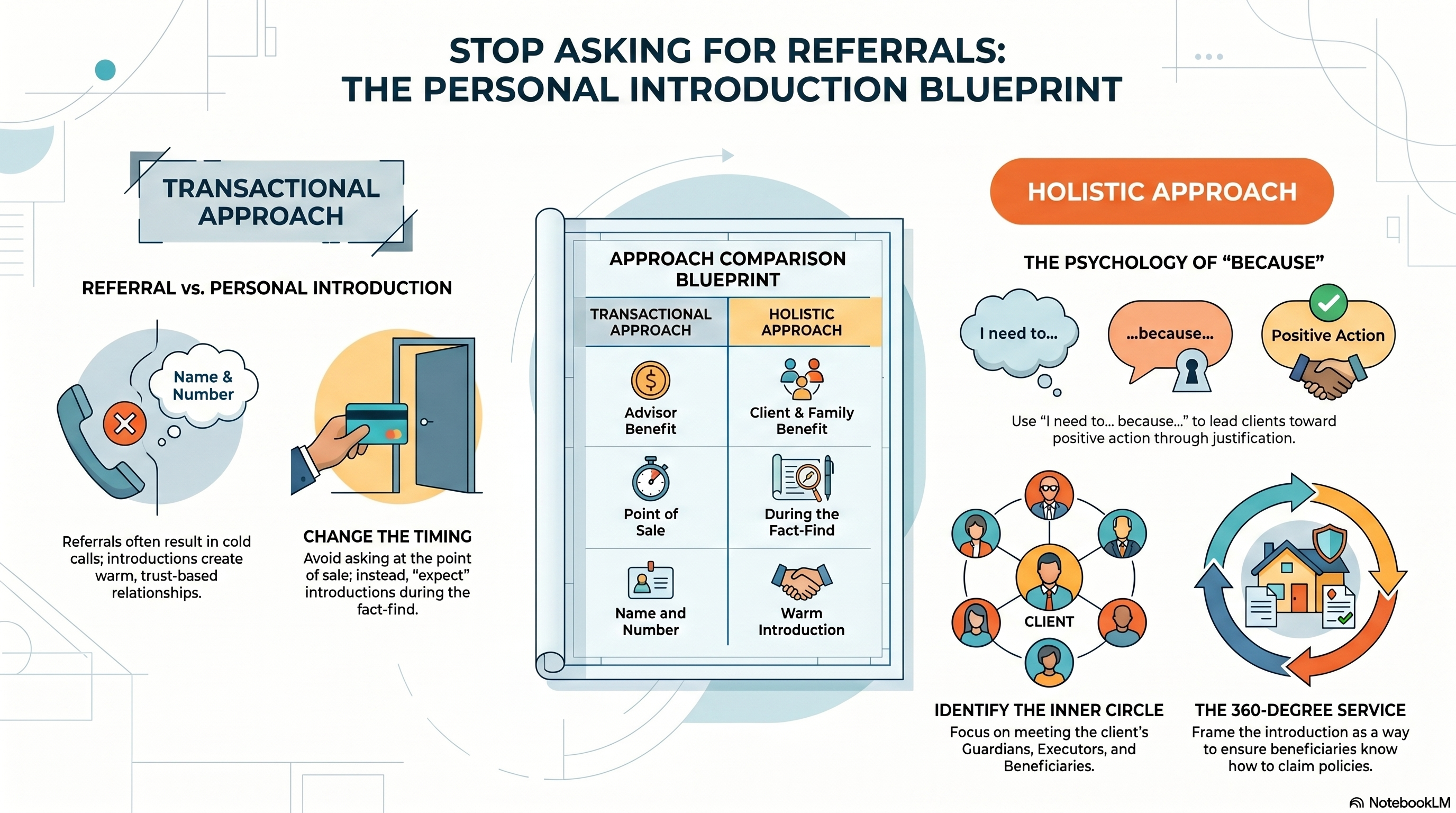
Because when most advisers think of a referral, they think of a name and a telephone number.
And at a basic level, you might say, “Well, isn’t that what we want?”
Yes — but only partly.
Because a name and a telephone number without a personal introduction is not really a referral. It is simply a cold call with slightly better information.
If someone gives you a name but does not properly introduce you, you are still contacting that person as a stranger. There is no relationship, no context, no trust, and no reason for that person to engage with you.
That is why I much prefer the phrase personal introduction.
A personal introduction is very different from a referral. It carries credibility. It has context. It comes with a reason. Most importantly, it transfers a level of trust from the existing client to the person they are introducing you to.
And that changes everything.
The Best Time Is Not the Point of Sale
I have often heard people say, “You should always be asking for referrals.”
It sounds good in theory, but in practice, it is far too glib.
Client relationships do not work like that. People do not want to feel as though every conversation is being engineered to get the adviser more business.
If we ask for referrals in the wrong way, at the wrong time, it can feel transactional.
And that is the real problem.
The best time to generate personal introductions is not when the client is signing paperwork.
The best time is during the fact-finding.
Now, that may surprise some people.
But when you think about it properly, it makes complete sense.
Why the Fact Find Creates the Perfect Opportunity
During fact-finding, we seek to understand the client’s world.
We are talking about their family, responsibilities, assets, liabilities, objectives, and what would happen if things did not go as planned.
We ask questions such as:
Who would look after your children in the event of your death?
Who would administer your estate?
Who would benefit from your estate?
Who would need to know what arrangements are in place?
Who would need access to important information at the most difficult time?
These are not artificial sales questions. These are essential planning questions.
When we discuss guardians, executors, beneficiaries, family members, business partners, and other people connected to the client’s financial life, we may naturally identify four, five, or six people who are directly involved in the client’s long-term planning.
And this is where the opportunity exists.
Not to ask for referrals.
But to explain why, as part of a holistic financial planning service, it is important for us to meet or speak with those people.
The Power of “I Need To… Because…”
There are three very important words that can completely change the nature of this conversation:
“I need to…”
And they become even more powerful when followed by a justification:
“I need to… because…”
There is a lot of psychology behind this.
When we give people a clear instruction followed by a reason, they are far more likely to take positive action.
Compare that with the traditional approach many advisers use:
“Would it be okay if you gave me the names of a few people?”
Or:
“Can you think of anyone who might benefit from speaking to me?”
Those questions put the client in control of deciding whether your request is valid. And very often, they will respond with something like:
“I can’t think of anyone at the moment.”
Or:
“Leave it with me.”
And we all know what usually happens after that.
Nothing.
But when we say, “I need to meet these people because…,” the conversation changes.
It becomes part of the advice process.
It becomes part of the service.
It becomes part of protecting the client and their family.
Make It About the Client, Not About You
The reason many referral conversations fail is that the benefit is obvious to the adviser but not to the client.
The adviser gets a new name.
The adviser gets a new prospect.
The adviser gets a potential new piece of business.
But what does the client get?
That is the question we must answer.
When personal introductions are positioned properly, the benefit to the client becomes clear.
For example, if a client has life assurance, investments, pensions, trusts, estate planning arrangements, or other important financial structures in place, then the people closest to them need to understand what exists.
They need to know who is involved.
They need to know where the money is.
They need to know how to make a claim.
They need to know who to contact.
They need to know who you are.
That is not prospecting. That is service.
That is not transactional selling. That is holistic financial planning.
When a client understands that, they are far more likely to say:
“Yes, of course. That makes complete sense. Let me introduce you.”
Holistic Planning Requires Wider Relationships
One of the great weaknesses in our profession is that too many advisers still operate on a transactional basis.
They arrange a policy, make an investment, complete the paperwork, and move on.
But a truly holistic financial planning service should be different.
It should be 360 degrees.
It should consider not just the client, but the people who may one day be responsible for carrying out the client’s wishes, receiving the client’s wealth, or making important decisions at a difficult time.
That could include spouses, children, guardians, executors, trustees, beneficiaries, attorneys, or business partners.
If these people are central to the client’s planning, then surely it makes sense for them to understand the plan.
And if it makes sense for them to understand the plan, then it makes sense for you to be introduced to them.
That is the difference between asking for referrals and earning personal introductions.
Stop Asking. Start Expecting.
The best advisers do not beg for referrals.
They do not awkwardly ask at the end of a meeting.
They do not make the client feel uncomfortable.
They build personal introductions into the planning process in a way that is professional, logical, and clearly beneficial to the client.
That starts during the fact-finding.
When you are discussing assets, liabilities, family responsibilities, estate planning, protection, and what happens in the event of death, the conversation naturally opens the door to the people who matter most in the client’s life.
At that point, you can say:
“I need to meet these people because, if anything happens to you, they need to understand what is in place, who benefits, where the money is, how to claim, and who to contact.”
That is a completely different conversation from:
“Do you know anyone else I could speak to?”
One sounds like prospecting.
The other sounds like professional responsibility.
The Lesson
If you want more referrals, stop asking for referrals.
Start creating personal introductions.
Do not wait until the point of sale. Do not make it a transactional request. Do not make it about you.
Make it part of your holistic financial planning process.
Use the fact find properly. Identify the people who are genuinely connected to the client’s financial life. Explain why it is in the client’s best interest for you to meet them.
And remember those powerful words:
“I need to… because…”
Instruction followed by justification leads to positive action.
And when the client sees the obvious benefit to them, they will be far more likely to introduce you to the people who matter most.
Download my best business resources for FREE!
This will help you to get multiple referrals (personal introductions) from new clients by using the right words and changing the dynamic of a question few of us find easy to ask.
We hate SPAM. We will never sell your information, for any reason.